Documentation › Key concepts
Key concepts
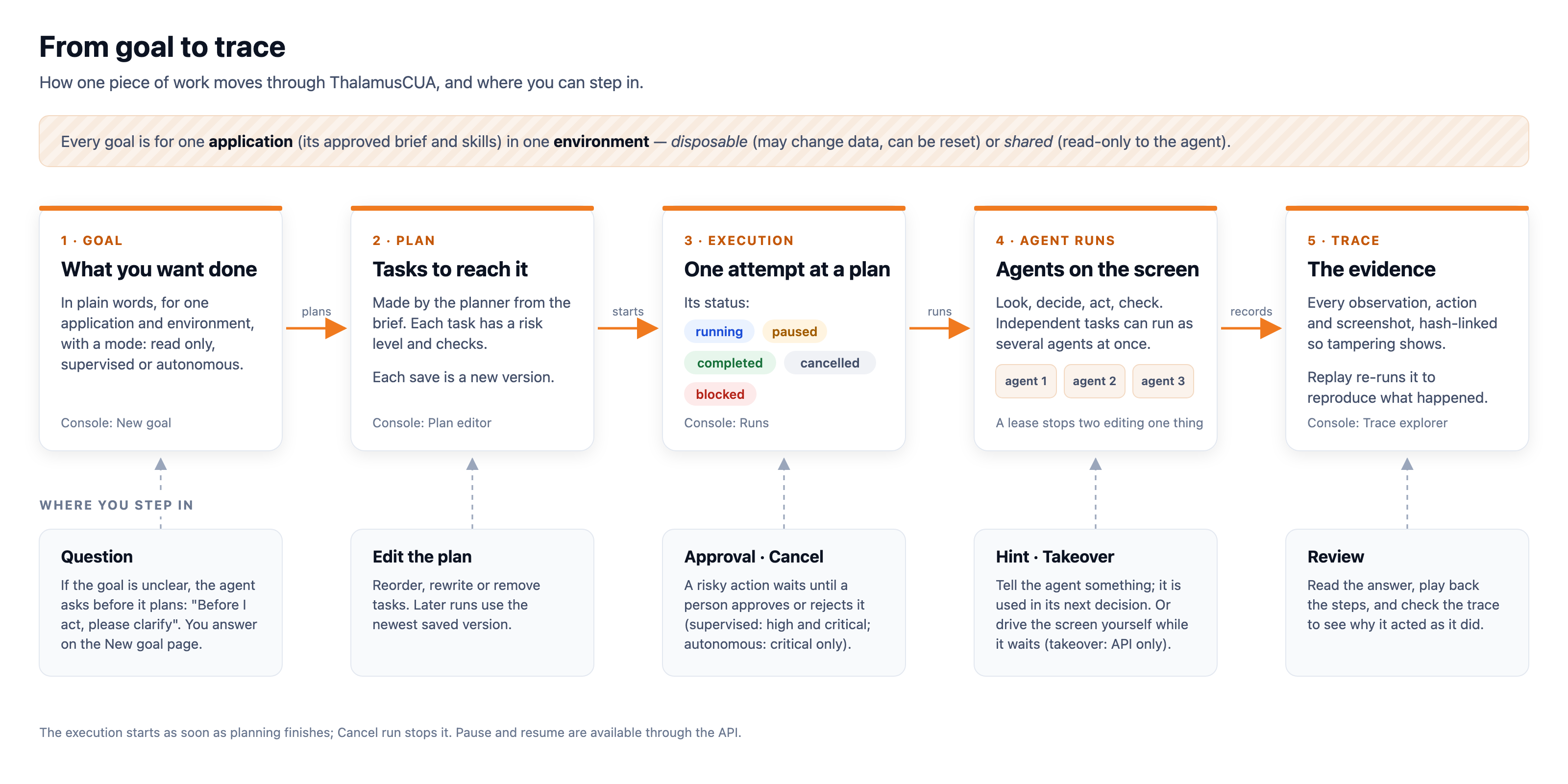
Six terms make the rest straightforward: application, environment, goal, plan, execution and agent run. The others are here too, with where they appear in the console.
The six core terms
- ApplicationEnvironments, Brief review
- A system the agent knows how to operate — for example ThalamusTrace or Thalamus SRE — described by a brief and a set of skills. Onboarded once, used by many goals.
- EnvironmentEnvironments
- One instance of an application. Disposable: the agent may change data, and it can be snapshotted and reset. Shared: read-only to the agent; writes are refused.
- GoalNew goal
- What you want done, in plain words, for one application and environment.
- PlanPlan editor
- The tasks the planner makes to reach the goal, each with a risk level and checks. You can reorder, rewrite or remove tasks in the Plan editor; each save is a new version.
- Execution (run)Runs
- One attempt at a plan, with a status: running, paused, cancelled, completed or blocked.
- Agent runRun detail
- One agent working inside an execution. Independent steps can run as several agents at once; a lease stops two of them editing the same thing.
During a run
- Skill
- A verified operation an application supports. When the agent lacks one for what it must do, it asks rather than guesses.
- ApprovalApprovals
- A high-risk action paused until a person approves or rejects it.
- QuestionNew goal
- The agent asking you to clarify a goal before it plans (“Before I act, please clarify”), rather than guessing.
- HintRun detail
- You telling the agent something while it runs; it is used in its next decision.
- TakeoverAPI
- You driving the screen yourself while the agent waits; your input is recorded too. Available through the API, not yet as a console button.
- TraceTrace explorer
- The recorded evidence of a run: every observation, action and screenshot, hash-linked so tampering shows.
What the agent knows
- BriefBrief review
- A description of an application — what it is, its screens, how it is used — that the agent plans from. Drafted by a model, then approved by a person; only an approved brief is trusted.
- SelectorBrief review
- How the agent finds a particular control on a screen. When a screen changes, a fix is proposed and a person accepts or rejects it.
Measuring
- Benchmark, suite, caseBenchmarks
- A benchmark is a set of test cases for an application, grouped into suites. Each case is a goal with checks on the result.
- EvaluationEvaluations
- Running a benchmark (or one suite) and scoring every case — on a real instance or the mock site.
- Mock site
- A stand-in for the application used in tests: fast and free, but it checks the plumbing rather than the model.
- Failure classificationEvaluations
- Each failure is tagged by kind; a confirmed one can be promoted into the regression suite.
- Model evaluationDocuments, Configurator
- A measurement of vision models on one machine — calibration, the S1 tasks and step time — kept under
docs/model-evaluations/. Its results appear on the Configurator when you pick a measured model. - Calibration
- Asking a model to point at 12 known targets on a 0–1000 grid over the screen; 11 of 12 is a pass. It shows how accurately the model can say where to click.
Integration
- Trigger
- A way for another system to submit work with a service token, optionally calling a webhook when it is done.
- Replay
- Re-running a recorded execution to reproduce what happened.
- Tenant
- Everything lives inside a tenant (the local one is called home).